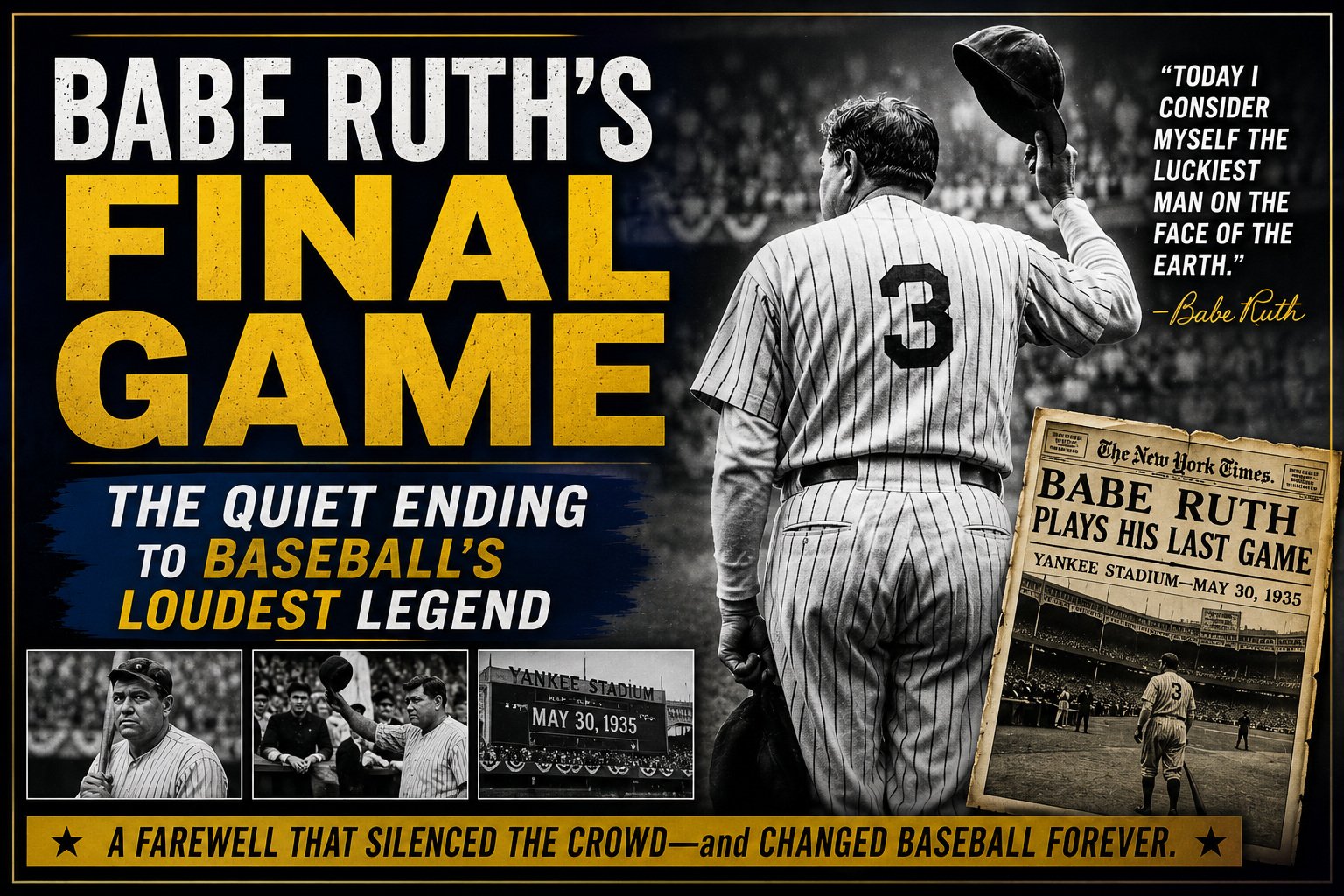
Babe Ruth’s final game did not look like the ending most fans would expect from the biggest name in baseball history.
There was no grand farewell tour. No perfect Hollywood moment. No final home run floating into the seats while the crowd roared one last time. Instead, Ruth’s final major-league appearance came quietly on May 30, 1935, at Baker Bowl in Philadelphia. He was no longer wearing the famous pinstripes of the New York Yankees. He was wearing the uniform of the Boston Braves, a struggling National League team that had hoped his name could bring fans through the gates.
By then, Babe Ruth was 40 years old. His legs were tired. His body was worn down. The swing was still legendary, but the daily grind of major-league baseball had caught up with him. For years, he had been larger than the game itself. In his final days as a player, the game looked larger than him.
That is what makes Babe Ruth’s final game so powerful. It was not a story about one last burst of glory. It was a reminder that even the greatest athletes eventually reach the end.
Quick Facts About Babe Ruth’s Final Game
| Detail | Information |
|---|---|
| Date | May 30, 1935 |
| Team | Boston Braves |
| Opponent | Philadelphia Phillies |
| Ballpark | Baker Bowl, Philadelphia |
| Final Score | Phillies 11, Braves 6 |
| Ruth’s Position | Left field |
| Ruth’s Final At-Bat | Groundout to first base |
| Final MLB Appearance | First inning |
| Retirement Announced | June 2, 1935 |
| Age | 40 |
Babe Ruth Was Not a Yankee in His Final Game
Many casual baseball fans assume Babe Ruth’s final game came with the New York Yankees. That is understandable. Ruth is almost impossible to separate from Yankee Stadium, pinstripes, and the home run boom that changed baseball forever.
But his final season came with the Boston Braves.
After the 1934 season, Ruth’s time with the Yankees was over. He still wanted a future in baseball, especially as a manager. The Braves offered him a deal that sounded bigger than a normal player contract. He would be a player, a vice president, and an assistant manager.
On paper, that sounded like respect.
In reality, the situation was complicated.
Ruth wanted a real path to managing. The Braves wanted his name, his fame, and the ticket sales that came with him. Fans still came to see him because he was Babe Ruth, but the player they saw in 1935 was not the unstoppable slugger of the 1920s.
He was a legend trying to squeeze one more chapter out of a body that had already given baseball everything.
The Road to the Final Game
Babe Ruth’s 1935 season started with attention, curiosity, and hope. The Braves were not a strong team, but Ruth’s presence created excitement. People wanted to see him. Newspapers still followed him. Every ballpark visit felt like an event.
But the season quickly became difficult.
Ruth’s bat was no longer consistent. His fielding had become a problem. His legs made it hard for him to cover ground in the outfield. Pitchers who once feared him could now challenge him more often.
Still, for one afternoon, the old Babe came back.
On May 25, 1935, against the Pittsburgh Pirates at Forbes Field, Ruth hit three home runs in one game. Those were the final three home runs of his career. It was a beautiful flashback, the kind of day that reminded everyone why he had become a national icon.
But that was not his final game.
That is where many people get the story wrong.
His final home runs came on May 25. His final game came on May 30.
Five days separated the last great Babe Ruth moment from the last official Babe Ruth appearance.
Babe Ruth’s Final Home Runs vs Final Game
| Event | Date | Opponent | Location | What Happened |
| Final three home runs | May 25, 1935 | Pittsburgh Pirates | Forbes Field | Ruth hit career home runs No. 712, 713, and 714 |
| Final MLB game | May 30, 1935 | Philadelphia Phillies | Baker Bowl | Ruth grounded out and left after playing left field |
| Retirement announcement | June 2, 1935 | — | — | Ruth officially stepped away from baseball |
This distinction matters because the May 25 game feels like the perfect ending. Three home runs. One last show. One final blast from the greatest slugger the game had ever seen.
But baseball history is rarely that neat.
The real ending came a few days later, and it was much quieter.
What Happened in Babe Ruth’s Final Game?
The Boston Braves played the Philadelphia Phillies on May 30, 1935, in the first game of a doubleheader at Baker Bowl.
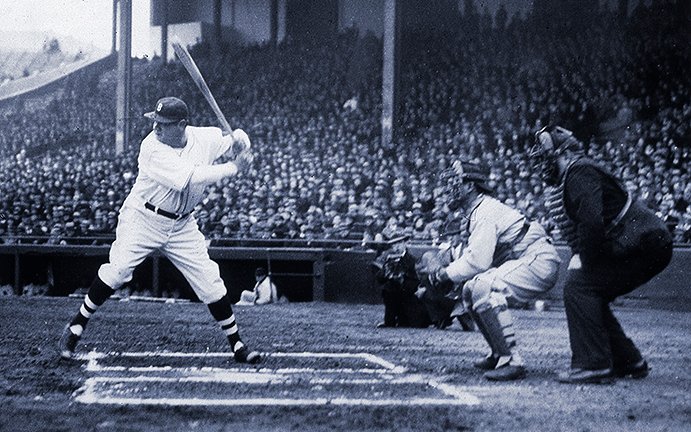
Ruth was in the starting lineup as the left fielder. He came to bat in the first inning. That plate appearance became the final at-bat of his major-league career.
He grounded out to first base.
No towering drive. No curtain call after a home run. No storybook swing.
Just a ground ball, an out, and the slow closing of a 22-year major-league career.
In the bottom half of the inning, Ruth went out to left field. His defensive struggles showed quickly. He was no longer the mobile outfielder he had once been. A ball dropped in front of him. Another ball got past him. He was credited with an assist on a relay play, but the Phillies scored early.
After the inning ended, Ruth left the field.
The crowd gave him a standing ovation. They did not know for certain that they had just watched his final major-league appearance, but they understood they were watching something historic. Ruth was not just another aging player. He was the face of a baseball era.
The Phillies went on to beat the Braves 11–6.
Babe Ruth’s Final At-Bat
Babe Ruth’s final at-bat was simple and almost painfully ordinary.
He grounded out to first base in the first inning.
That is the strange beauty of baseball. A career can contain 714 home runs, World Series glory, pitching dominance, impossible fame, and then end with a routine groundout.
For Ruth, the final at-bat did not define the career. It revealed something human about it.
Every great player eventually has a last swing. Most of them do not get to choose how it looks.
Why Babe Ruth’s Final Game Felt So Sad
Babe Ruth’s final game feels sad because it showed the gap between the legend and the aging man.
Fans remembered the Ruth who changed baseball with his power. The Ruth who made home runs the center of the sport. The Ruth who packed stadiums. The Ruth who turned the Yankees into a dynasty. The Ruth who made children dream about swinging big.
But in 1935, the Ruth on the field was struggling. His body was heavy. His movements were slow. His role with the Braves was awkward. His hope of becoming a manager was fading.
The end did not come because fans stopped caring. They still cared deeply. It came because the game had finally passed his body by.
That is why his final game remains memorable. It was not dramatic in the usual sports-movie way. It was dramatic because it was real.
The Boston Braves Gamble
The Braves brought Ruth in for several reasons. They wanted attention. They wanted fans. They wanted hope. They also knew that Babe Ruth’s name still carried enormous power.
At first, the move worked as publicity. Ruth was still a headline. Any game with him in the lineup mattered more than an ordinary Braves game.
But as a baseball decision, it was difficult.
Ruth was no longer able to play every day at a high level. The Braves were a poor team. The promises of an executive or managerial future did not turn into the kind of role Ruth wanted.
By early June, the relationship was broken. Ruth retired from the Braves and never played professional baseball again.
Babe Ruth’s Final Season With the Braves
| Category | 1935 Season Context |
| Team | Boston Braves |
| League | National League |
| Ruth’s Age | 40 |
| Main Role | Player, assistant manager, vice president title |
| Main Problem | Declining body and unclear future with the team |
| Brightest Moment | Three home runs against Pittsburgh on May 25 |
| Final Game | May 30 against Philadelphia |
| Retirement | June 2, 1935 |
Ruth’s final season was short, uneven, and uncomfortable. Still, it added one fascinating final chapter to his career. It showed him outside the Yankees machine, trying to remain part of the game he had helped transform.
Why the May 25 Game Is More Famous
The May 25 game is more famous because it gave fans one last glimpse of the old Babe Ruth.
Three home runs in one afternoon was not just impressive. It was symbolic. Ruth had built his legend on the home run, and his final home runs came in a burst that felt almost mythical.
His last home run, No. 714, became one of the most famous final homers in baseball history.
That number stood as the all-time career home run record until Hank Aaron passed it in 1974.
So when people remember the end of Ruth’s career, they often remember May 25, not May 30. They remember the thunder, not the silence.
But the final game matters because it tells the whole truth.
The Difference Between a Final Highlight and a Final Game
Sports history often remembers the highlight better than the ending.
Babe Ruth’s final highlight was the three-homer game in Pittsburgh.
Babe Ruth’s final game was the quiet afternoon in Philadelphia.
Both are important.
The first shows the greatness that still lived inside him. The second shows the reality that greatness cannot last forever.
Together, they create a more complete ending than either one alone.
Babe Ruth’s Career Legacy
Babe Ruth did more than hit home runs. He changed what baseball could be.
Before Ruth, baseball was often built around bunts, stolen bases, hit-and-run plays, and low-scoring strategy. Ruth made power the main attraction. He showed that one swing could change a game, a season, and even the business of baseball.
He was also more than a player. He was a celebrity before modern sports celebrity fully existed. Children copied his swing. Newspapers followed his life. Fans traveled to see him. His name became bigger than any single team.
Ruth finished his career with:
- 714 home runs
- 2,214 RBIs
- 2,873 hits
- A .342 career batting average
- Seven World Series championships
- A legendary pitching record before becoming a full-time hitter
- A permanent place as one of baseball’s most important figures
His final game was quiet, but his career was anything but.
Why Babe Ruth’s Final Game Still Matters
Babe Ruth’s final game matters because it reminds us that legends do not stop being human.
It is easy to remember Ruth only as a giant: the Sultan of Swat, the home run king, the man who made baseball bigger, louder, and more exciting.
But on May 30, 1935, he was also a tired 40-year-old athlete standing in left field, trying to give the game one more day.
That image is powerful.
It does not weaken his legacy. It makes it more real.
The greatest players are not great because they avoid decline. They are great because their peak was so extraordinary that even the decline becomes part of the story.
Final Thoughts: A Quiet Goodbye for Baseball’s Loudest Star
Babe Ruth’s final game did not end with a home run. It ended with a groundout, a difficult inning in left field, and a slow walk away from the diamond.
At first, that may feel disappointing.
But maybe it is the right ending after all.
Ruth had already given baseball the thunder. He had already given fans the home runs, the headlines, the records, the personality, and the mythology. By the time he left Baker Bowl, there was nothing more he needed to prove.
His final game was not the end of Babe Ruth the legend. It was only the end of Babe Ruth the player.
The legend kept going.
And nearly a century later, people are still asking about that final game.
That says everything.
Frequently Asked Questions About Babe Ruth’s Final Game
When was Babe Ruth’s final game?
Babe Ruth’s final major-league game was on May 30, 1935.
Who did Babe Ruth play for in his final game?
Babe Ruth played for the Boston Braves in his final game.
Who was Babe Ruth’s final game against?
His final game was against the Philadelphia Phillies.
Where was Babe Ruth’s final game played?
Babe Ruth’s final game was played at Baker Bowl in Philadelphia.
What happened in Babe Ruth’s final at-bat?
Babe Ruth grounded out to first base in the first inning.
Did Babe Ruth hit a home run in his final game?
No. Babe Ruth did not hit a home run in his final game.
When did Babe Ruth hit his final home run?
Babe Ruth hit his final three home runs on May 25, 1935, against the Pittsburgh Pirates.
What was Babe Ruth’s final career home run number?
Babe Ruth’s final career home run was No. 714.
When did Babe Ruth retire?
Babe Ruth announced his retirement on June 2, 1935.
Why was Babe Ruth playing for the Braves?
After leaving the Yankees, Ruth joined the Boston Braves in 1935. He hoped the move might lead to a future managerial role, but the arrangement did not work out.
Was Babe Ruth still good in 1935?
Ruth could still show flashes of greatness, especially in his three-home-run game on May 25, but his body had declined and he could no longer play at his old level.
Why is Babe Ruth’s final game important?
It marks the last official appearance of one of the most famous players in baseball history. It also shows the human side of a legend whose career had been larger than life.